Your reports
The four Discover situations
What A, B, C and D mean and how we decide.
Every site gets one of four Discover situations. It tells you, in one letter, whether Discover is the problem to solve or the traffic to protect. We work it out from your own Search Console figures for the last 28 days.
Under 1,000 Discover impressions in 28 days. Google is barely showing your pages in Discover. The focus is on what gets a site picked up: large images, clear authorship, original reporting and timely topics.
Discover shows your pages, but people rarely tap them: your click-through rate is clearly below your own usual rate, or below 3% if there isn't enough history to compare. The focus is on images and headlines.
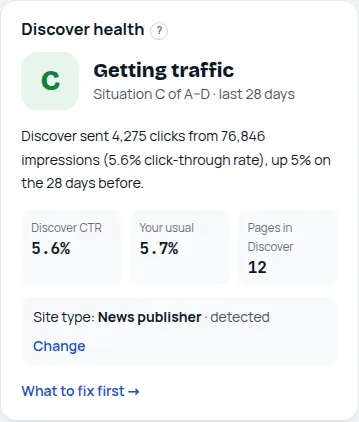
Discover sends steady clicks. The focus is on doing more of what works and protecting it.
Clicks dropped by more than 40% on the previous 28 days, Discover stopped showing the site, or weekly clicks over the last 12 weeks swing far more than normal. The focus is on finding what changed.
How we decide
- Did Discover stop showing you?If the 28 days before had 1,000+ impressions and these 28 days don't, that's a drop: D.
- Are you in Discover at all?Under 1,000 impressions: A.
- Are people clicking?Click-through rate clearly below your usual (the median of earlier weeks, less a quarter): B.
- Is it steady?A fall of over 40% (from at least 100 clicks), or big weekly swings: D. Otherwise: C.
Sites with less than 90 days of history aren't judged on trends, since there isn't enough to compare.
Google publishes no official thresholds for Discover. These rules are ours, set so the letter matches what a publisher would conclude looking at the same figures. The report always shows the numbers behind the letter.
Last updated 24 October 2026